


Two reviews of this product already exist on the wider web and both answer the same question: what does the software do and what does it cost. This one answers a narrower and more useful question. If you run several legal entities and you are weighing Joiin consolidation against a spreadsheet, what exactly does the platform do to your numbers, which plan do you actually need to do it, and where does the sales copy run ahead of the feature table?
How this review was done. Every figure below was read on 22 October 2026 from the public Joiin website: the consolidations page, the inter-company and multi-currency feature pages, the security page and the live pricing calculator, with the currency selector confirmed as USD. No account was created, no trial was started and no data was connected. This is a desk review of what the company publishes, and every claim is attributed to the page it came from. The live site is here if you want to check any number as you read.
What Joiin consolidation actually does to your numbers
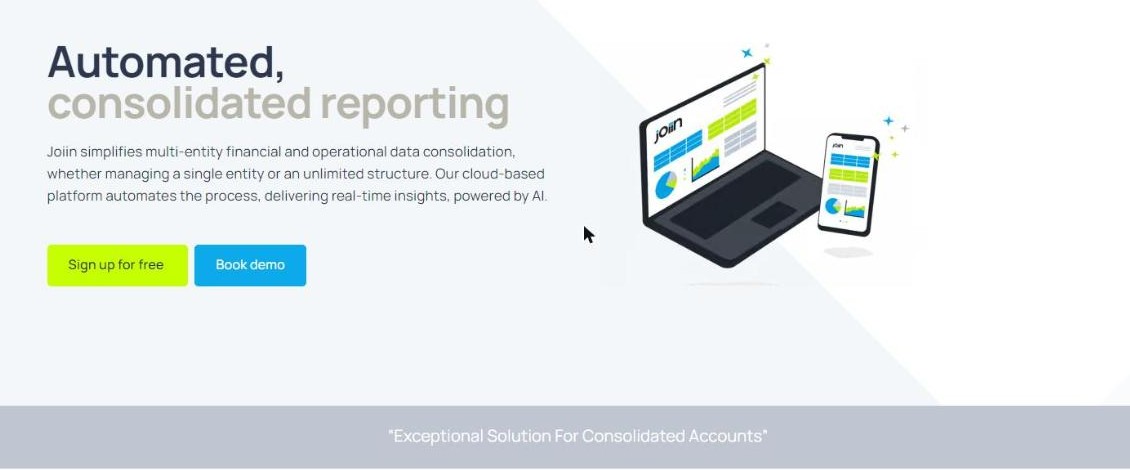
Joiin consolidation sits on top of your accounting ledgers rather than replacing them. It pulls the chart of accounts and the transactions from each entity you connect, maps those accounts together, applies eliminations, converts currencies where needed, and produces a consolidated set of financial statements from the result.
The company describes the scope as “multi-entity financial and operational data consolidation, whether managing a single entity or an unlimited structure”. In practice the Joiin consolidation workflow replaces the spreadsheet that most finance teams build by hand once a group grows past two or three companies, and the value is less in any single feature than in not rebuilding that spreadsheet every month.
It is worth being clear about what Joiin consolidation is not. Joiin is a reporting layer, not a general ledger and not an audit tool. The underlying bookkeeping still happens in Xero, QuickBooks, Sage or whichever system each entity uses.
Which ledgers Joiin consolidation connects to, and how to count them
The Joiin consolidation integrations menu shows thirteen tiles. The pricing page lists ten. Both are accurate; they are counting different things, and the difference matters when you are checking whether your own stack is covered.
| Type | Listed |
| Accounting ledgers | Xero, QuickBooks, Intuit Enterprise Suite, Sage, MYOB, FreeAgent, Puzzle, Pennylane, Zoho Books, Fortnox |
| Not ledgers | Excel Add-In, Zapier, Stripe, and “Unplugged” (spreadsheet import) |
So the honest number for Joiin consolidation is ten accounting systems, plus four ways to get data in or out that are not ledgers at all. The spreadsheet route matters more than it sounds: if one entity in your group is on a system nobody integrates with, it can still be folded in manually rather than blocking the whole consolidation.
One small inconsistency worth knowing before you plan around it: Intuit Enterprise Suite appears on the pricing page list but not as its own tile in the integrations menu.
Eliminations and partial ownership in Joiin consolidation
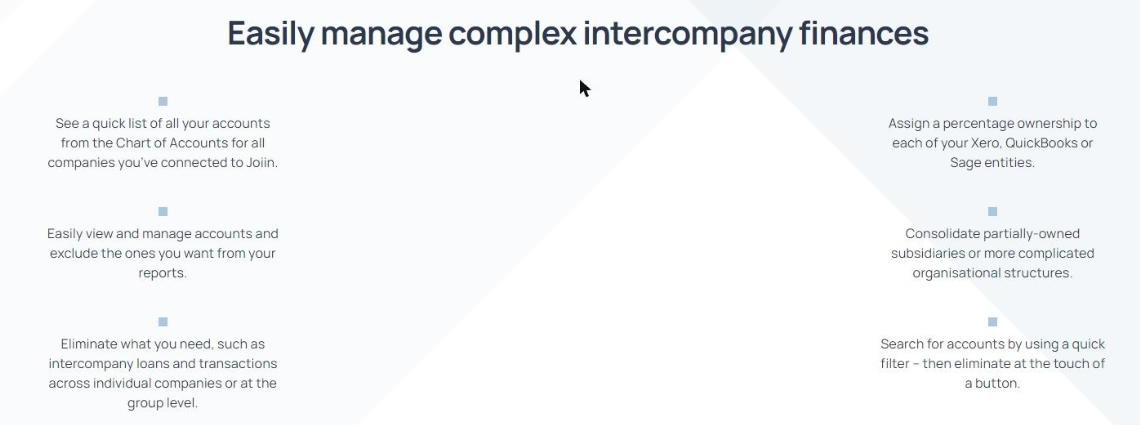
This is the part that separates real consolidation from simply adding two trial balances together, and the published detail is specific enough to evaluate.
Joiin consolidation shows the combined chart of accounts across every connected company, with accounts matched on code, number, name and type. From that list you mark what should be eliminated: intercompany loans, management fees, internal sales. The company states that eliminations can be applied to individual companies or at the group level, which is the distinction that matters when a transaction only nets off between two of your five entities.
The feature that will decide the tool for some groups is further down the same page: you can assign a percentage ownership to each entity and consolidate partially-owned subsidiaries. Any group with a joint venture or a minority stake needs that, and plenty of mid-market reporting tools do not offer it.
If you want the accounting framework these mechanics are serving, the IFRS Foundation publishes IFRS 10 Consolidated Financial Statements, which is where the control and ownership definitions behind any consolidation come from.
Multi-currency Joiin consolidation: which rate gets used where
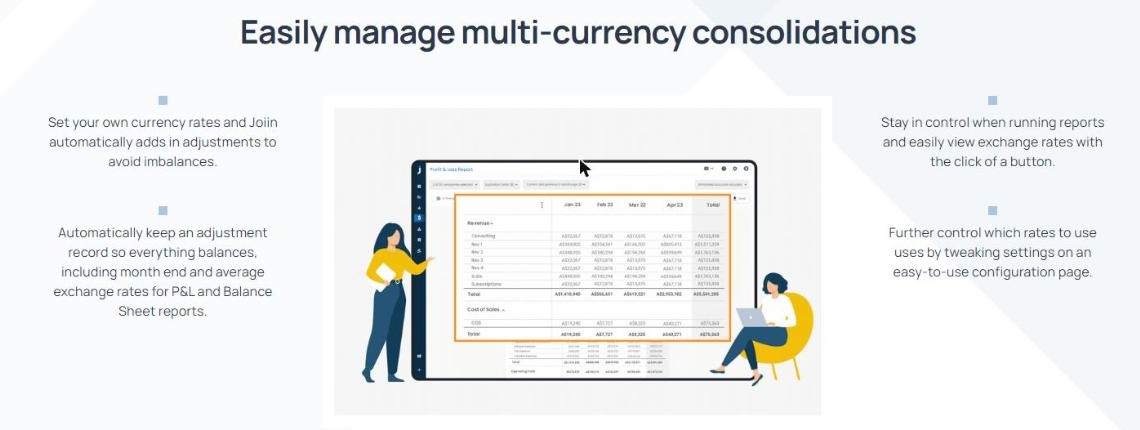
Currency is where consolidations quietly go wrong, so the published Joiin consolidation behaviour deserves reading closely. Joiin converts each entity into a single reporting currency of your choice, and the company states it supports all currencies.
Three specifics are published and all three are the right answers. Joiin automatically adds adjustments to avoid imbalances when rates are applied, it keeps an adjustment record so the movement is traceable rather than silent, and it uses month-end rates for the balance sheet and average rates for the profit and loss. That last point is the conventional treatment and it is reassuring to see it stated rather than left implied.
You can also view the exchange rates used from the report itself and change which rates apply on a configuration page. For anyone who has spent an afternoon explaining a translation difference to an auditor, that audit trail is the feature worth paying for.
What Joiin consolidation costs as you add entities
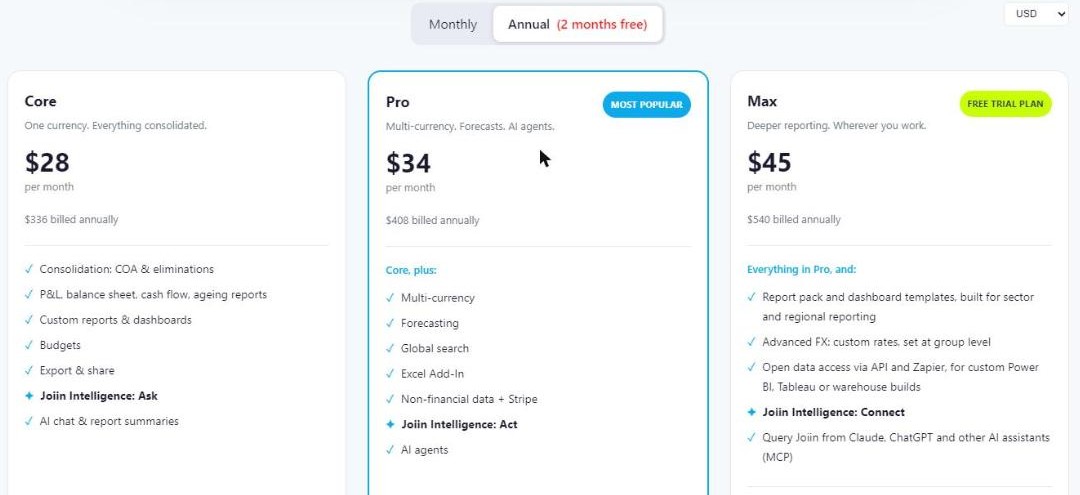
Joiin consolidation pricing is driven by a slider for the number of companies, three plans, and a monthly or annual toggle. These are the annual-billing figures, expressed per month, read from the live calculator in USD. The site also offers GBP, EUR, AUD and NZD.
| Companies | Core | Pro | Max | Core per company |
| 1 | 28 | 34 | 45 | 28.00 |
| 2 | 32 | 36 | 47 | 16.00 |
| 5 | 62 | 66 | 77 | 12.40 |
| 10 | 97 | 104 | 115 | 9.70 |
| 20 | 147 | 155 | 168 | 7.35 |
| 50 | 179 | 189 | 202 | 3.58 |
| 100 | 280 | 297 | 325 | 2.80 |
Beyond a hundred entities the site quotes a rate of 2.80 USD per additional company, which lines up exactly with the per-company figure in the bottom row. The trial is 14 days and the page states no credit card is required.
The finding: Joiin consolidation cost per entity falls about tenfold
Read the last column on its own. A single entity on Core costs 28 USD a month. A hundred entities on Core costs 280 USD a month, which is 2.80 per company — one tenth the unit price. Joiin consolidation is priced for groups, and the arithmetic is not subtle once you do the division, but the site never presents it this way.
There is a kink worth noticing in the middle of the ladder. Going from 20 to 50 companies raises the Core price from 147 to 179, a 22% increase for two and a half times the entities. Going from 50 to 100 raises it from 179 to 280, a 56% increase for twice the entities. Anyone sitting just under 50 entities is in the most efficient part of the curve.
The second finding: the Joiin consolidation plan gap collapses at scale
Now compare the Joiin consolidation plans across the columns instead of down them. At one company, Max costs 45 against Core at 28 — a 61% premium. At fifty companies it is 202 against 179, a 13% premium. At a hundred it is 325 against 280, about 16%.
The practical consequence is slightly backwards. The advanced capabilities — multi-currency, custom FX rates, API access — are nearly free once you are a large group, and proportionally expensive for the single-entity business that is only testing the water. If you expect to grow into a multi-currency structure, the upgrade gets cheaper in relative terms as you do.
Where the sales pages run ahead of the feature table
Two parts of Joiin consolidation are advertised in general terms on the feature pages and gated by plan in the comparison table. Both are published by the company; they simply are not published in the same place.
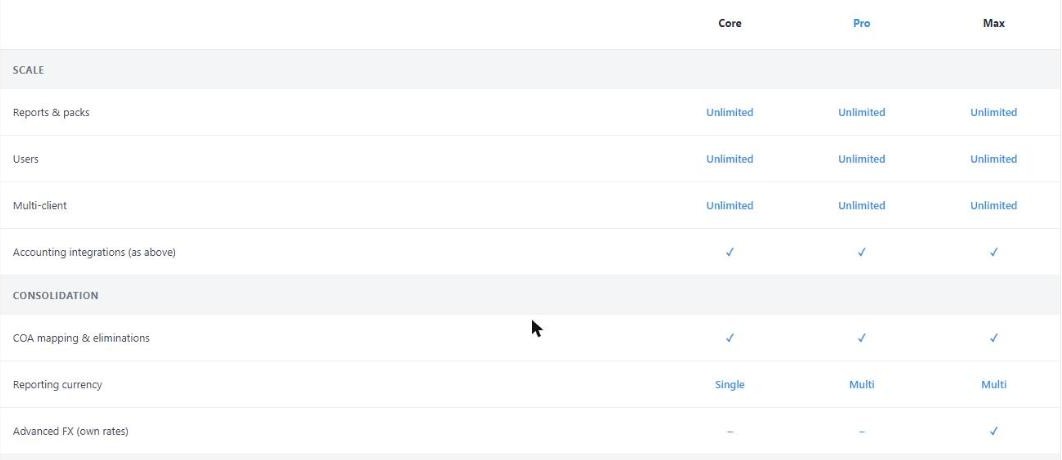
Multi-currency is not on the entry plan. The consolidations page lists “multi-currency and global ready” among the headline capabilities and the dedicated feature page explains at length how conversion works. The plan table reads Reporting currency: Single / Multi / Multi. On Core you consolidate into one currency only; multi-currency Joiin consolidation starts at Pro.
Setting your own rates is a Max-only feature. The multi-currency page says you can “use our default exchange rates or enter your own”. The plan table lists Advanced FX (own rates) as unavailable on Core, unavailable on Pro, and available on Max. If your group books translations at a board-approved rate rather than a market feed, that is the top plan, not the middle one.
Neither is hidden and neither is unusual commercially. But a buyer reading only the feature pages would reasonably expect both on any paid plan, so it is worth checking the table before choosing. The plan comparison is at the foot of the pricing page.
The third finding: “2 months free” is not two months on every plan
The Joiin consolidation billing toggle is labelled Annual (2 months free). Switching between the two states gives the monthly and annual prices for a single company, and the saving is not the same on all three plans.
| Plan | Monthly | 12 months at monthly rate | Annual price | Saving |
| Core | 35 | 420 | 336 | 84 (2.4 months) |
| Pro | 42 | 504 | 408 | 96 (2.3 months) |
| Max | 49 | 588 | 540 | 48 (under 1 month) |
Core and Pro deliver the promise and slightly beat it. On Max the annual commitment saves 48 USD against twelve months at the monthly rate, which is a little under one month rather than two. It is a single multiplication anyone can repeat, and it is the number to check before committing a year up front on the top plan.
What every plan includes, which is more than most
The generous part of the Joiin consolidation pricing is easy to miss because it sits in the rows that are identical across all three columns.
Unlimited reports and report packs, unlimited users, and unlimited multi-client access on every plan including Core. Per-seat pricing is the norm in this category, and its absence here is a real differentiator for a finance team that wants the whole board looking at the same live numbers. Chart-of-accounts mapping and eliminations are also on Core, so the core consolidation mechanics are not themselves an upsell.
What is gated above Core: forecasting, global search, the Excel add-in, Stripe and non-financial data, and the AI agents. Reserved for Max: open data access via API and Zapier for Power BI or a warehouse, white labelling, which the table marks as coming soon, and an MCP connector that lets Claude, ChatGPT or another assistant query your Joiin data directly.
Joiin consolidation security and where the data actually sits
For a tool holding a whole group ledger, the security position published alongside Joiin consolidation is specific rather than decorative. Joiin states that it runs entirely on Amazon Web Services, offers two-factor authentication on any user account, and uses SSL across its applications and APIs.
Two statements matter more than the rest. The company says it stores a copy of certain parts of your financial data inside AWS high-security zones in order to produce reports quickly — so this is not a pure pass-through, and your numbers do rest with the vendor. Against that, it states that deleting a company from Joiin fully deletes the data and the access tokens held with the QuickBooks, Sage or Xero APIs, which is the clean exit most reporting tools do not describe in writing. Card and billing details are held only with Stripe.
Who Joiin consolidation suits, and who should look elsewhere
A strong fit for a group of five to fifty entities on supported ledgers. That is where the per-company price has dropped sharply but the structure is still simple enough that a reporting layer beats a finance system migration.
A strong fit if many people need the reports. Unlimited users on every plan changes the calculation against per-seat competitors more than any single feature does.
A strong fit for accounting practices. Unlimited multi-client access is included from Core rather than sold as a practice edition.
Check the plan carefully if you are multi-currency. One entity reporting in one currency is fine on Core; anything cross-border starts at Pro, and board-set FX rates mean Max. Run your own entity count through the pricing calculator before assuming a tier.
Less suited if your entities sit on unsupported ledgers, where you would be importing by spreadsheet and losing much of the automation, or if you need statutory consolidation with audit sign-off built in rather than management reporting.
Getting data out of Joiin consolidation again
A reporting layer is only as useful as the exits it offers, and this is an area the feature table answers more clearly than the marketing pages.
Every plan can export and share in PDF, CSV and Excel, so the basic Joiin consolidation output is portable from the entry tier. Report packs, custom layouts and dashboards are also on Core, which means a board pack can be produced and circulated without an upgrade.
Two routes out are gated. The Excel add-in, which pulls live figures into a workbook rather than a static export, starts at Pro. Open data access through the API and Zapier, which is what you need to feed Power BI, Tableau or a warehouse, is Max only. If your group already reports through a BI layer, the Joiin consolidation tier you need is decided by that requirement alone, before any entity count comes into it. The integrations and export options are listed on the site.
The short version
Joiin publishes more detail about its consolidation than most of this category: the exact FX treatment, eliminations at company or group level, percentage ownership for partial subsidiaries, a live price for any entity count, and a security page that says where the data sits. The 14-day trial needs no card. On transparency it does well.
Three things to settle before you pay. Multi-currency consolidation starts at Pro, not Core, despite the feature pages advertising it generally. Setting your own exchange rates is Max only. And the “2 months free” annual label holds on Core and Pro but is worth under one month on Max.
None of that changes the overall picture. For a multi-entity group already on Xero, QuickBooks or Sage, Joiin consolidation does the unglamorous monthly work that otherwise eats a week, and it gets cheaper per entity the more of them you have.
Overall: 8.6 / 10






Reviews
There are no reviews yet.