

A Different Kind of Watch Brand Story
Most watch brand origin stories follow a predictable arc. A Swiss heritage. A founding legend. A master watchmaker with a surname that sounds distinguished. Generations of tradition. A price tag that reflects all of the above — plus the marketing budget required to keep telling that story to you over and over again.
Boderry’s origin story is different. Gary Hau, whose family has deep roots in the watchmaking trade, founded Boderry in 2019 with a premise that was either naive or visionary depending on how you look at it: be completely transparent about being a Chinese watch manufacturer, put the money that would have gone into brand mystique directly into the components, and see whether quality can stand on its own without heritage or mystique to prop it up.
Four years later, independent reviewers are calling the Boderry Voyager the best field watch under $100 on the entire market. Watch collectors with over 60 pieces in their personal collections are describing the Boderry Admiral GMT as one of their favorites. People who own Rolex Submariners are wearing a Boderry on vacation and leaving the Rolex at home.
This is the full, honest story of what Boderry has built — and where the limits of that story genuinely lie.
What Is Boderry?
Boderry is a direct-to-consumer Chinese microbrand watch company that designs, assembles, and sells mechanical automatic watches directly through its website at boderry.com and through Amazon. The brand’s stated philosophy is transparency — they are openly Chinese, openly forthcoming about the components they use, and openly positioning themselves against what they describe as scammer brands who rebrand generic off-the-shelf products from wholesale platforms without disclosure.
Unlike many brands in the affordable watch space, Boderry does not purchase watches from a third-party factory and slap their name on them. They assemble watches in their own facility — sourcing Japanese movements from Seiko and Miyota, sapphire crystals, and titanium cases, and combining them into watches that the brand designs itself. The distinction between rebranding and assembling matters for quality control, for component selection, and for the brand’s ability to respond to documented issues — which, as this review will cover, is sometimes tested.
The product lineup includes the Voyager field watch, the Landmaster field watch, the Sea Turtle titanium diver, the Admiral GMT, the Urban Skeleton, and several additional models at various price points. Every model in the core lineup shares the brand’s commitment to titanium cases, sapphire crystals, and Japanese automatic movements — specification combinations that competing brands at comparable prices simply cannot match.
Who Is Boderry For?
Boderry speaks most directly to a specific kind of watch buyer — one who cares deeply about what is inside the watch rather than whose name is on the dial.
First-time automatic watch buyers who want the genuine mechanical experience without paying the premium that established names charge for their first entry into the category. Field watch enthusiasts who understand what titanium, sapphire, and a Seiko movement represent in terms of component quality and who want those components at a price that leaves room in the budget for a strap upgrade. Watch collectors who already own expensive timepieces and want a daily beater that they can wear hard without anxiety — something that gets wet, gets scratched, gets forgotten in a bag — without the psychological cost of risking a more expensive watch. GMT complication seekers who have been frustrated by the price of most dual-timezone watches and want genuine GMT functionality with a Seiko NH34A movement at a price that most field watch buyers pay for a basic three-hander.
Boderry is less appropriate for buyers who prioritize brand recognition and the social signals that come from a recognized logo, for buyers who need the certainty of an established dealer network and in-person service, and for buyers who are unwilling to tolerate the quality control variability that is inherent in purchasing from a young, growing microbrand rather than an established manufacturer with decades of refined production processes.
The Boderry Lineup: Model by Model
The Voyager — The Watch That Built the Brand
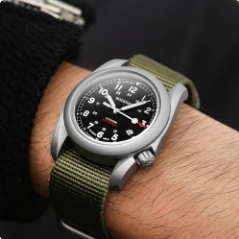
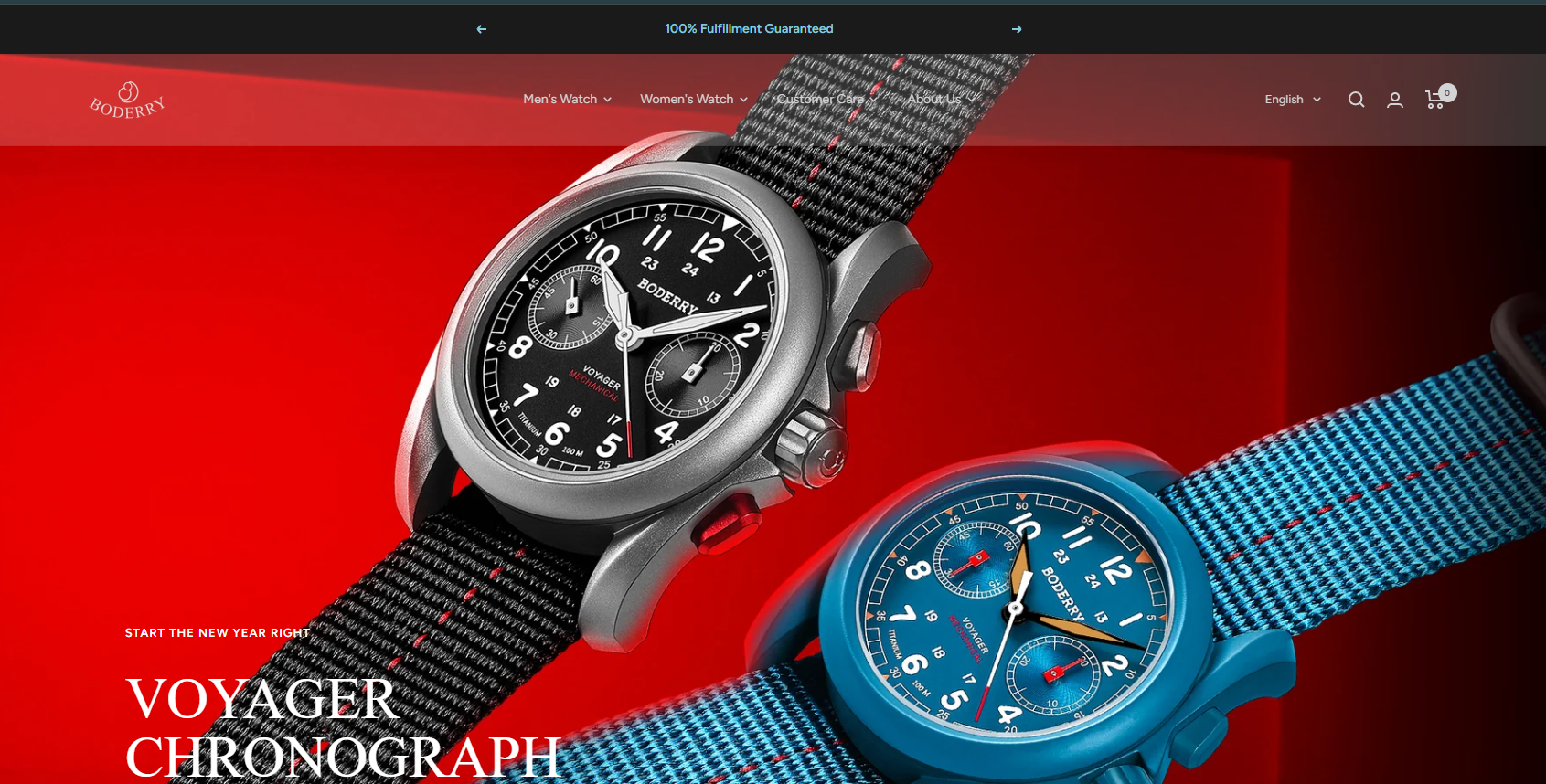
The Boderry Voyager is the product that put Boderry on the map of the serious watch community — and the one that has generated the most extensive independent testing and review coverage.
The specification sheet is the first thing that catches attention. A 40mm titanium case in sandblasted finish — lighter than stainless steel and stronger than aluminum. A Seiko NH35A or Miyota 8215 automatic movement — the workhorse calibers that have earned a reputation for reliability across millions of watches worldwide. A sapphire crystal recessed approximately half a millimeter into the raised bezel — providing additional protection against edge impacts that a flush-mounted crystal cannot. A screw-down crown at the four o’clock position — the same placement used by field watch specialists who know that a three o’clock crown creates a pressure point against the back of the hand during normal wear. One hundred meters of water resistance. A NATO strap that is widely praised for its construction quality, if criticized for its initial stiffness.
The price of this specification package is approximately $99 to $120 depending on where you purchase and what promotions are currently active.
Adventure Alan — the outdoor gear review publication that tested the Voyager rigorously across real field use — described it as the most bang-for-your-buck on the entire field watch market. The conclusion was direct: easily the best for under $100, and frankly, nothing else even comes close. The comparison context matters here. The Voyager was compared against the Bertucci DX3, the Hamilton Khaki Field, the Timex Expedition Scout, and the Seiko 5 Sports — established names across a range of price points. The Voyager was found to compete with or exceed each of them on the specific combination of specifications at its price point. Most major brands would sell a watch of this quality for $300 to $400.
The real-world movement accuracy reflects well on the Seiko NH35A. Testing across six days found the movement gaining only a few seconds overall — frequently losing approximately five seconds during waking hours and recovering that loss overnight, resulting in a net daily variation of just a couple of seconds. This is well within the official rating and reflects how these calibers behave in real use rather than controlled laboratory conditions.
The Voyager’s design is openly acknowledged as a homage to Bertucci field watches — a transparency that the brand does not hide and that independent reviewers consistently acknowledge. The crown placement, the lug width, the overall silhouette — these are clearly Bertucci-inspired. For buyers who consider this intellectual dishonesty, the Voyager will not satisfy. For buyers who consider it honest appropriation of a proven design formula, the Voyager delivers that formula in titanium with an automatic movement at a price that a genuine Bertucci cannot match in equivalent materials.
One specific design characteristic that generates consistent discussion is the titanium case’s appearance. Titanium looks duller than stainless steel — this is a material property, not a manufacturing defect. The sandblasted finish amplifies this matte quality. For buyers who associate a watch’s quality with the visual pop of a polished steel case, the Voyager will look understated. For buyers who appreciate titanium’s combination of lightness, strength, and understated field utility, the matte finish is exactly appropriate for a tool watch designed to be worn rather than displayed.

The Admiral GMT — GMT Complications at Field Watch Prices
The Admiral GMT is perhaps Boderry’s most ambitious product — packing a GMT complication and a Seiko NH34A movement into a titanium case with sapphire crystal and 200 meters of water resistance at a price point under $150.
The GMT complication allows tracking of a second time zone through an independently jumping red GMT hand — the office or caller GMT mechanism that allows setting the local hour hand without moving the GMT hand, enabling easy adjustment when traveling. This is the same fundamental function that GMT watches at five to ten times the price provide.
The Admiral GMT features bi-directional bezels with aluminum inserts in either Coke or Pepsi color schemes — black and red, or blue and red — for visually tracking the second timezone against the 24-hour scale on the bezel. The sapphire crystal is flush with the bezel and anti-reflective coated, with reviewers confirming that glare was not problematic in any tested lighting condition. The caseback is screw-down with a three-dimensional five-pointed star relief — a design element that the Ben’s Watch Club reviewer described with appropriate good humor as hinting at the desire to really push the specs of this piece.
The honest limitations of the Admiral GMT reflect the realities of producing a sub-$150 GMT watch. The lume application is described by independent reviewers as painted on top of the applied indices rather than filling hollow indices with Super-LumiNova — a cost-saving approach that compromises longevity of the glow. After being charged with light, the Boderry loses its lume relatively quickly — within a minute or so — where premium alternatives would glow significantly longer. The bezel colors are described as inexpensive in execution, with the reds tending toward a pinkish-purple rather than a pure red. The bracelet, for buyers who choose that configuration, is described as the most obvious area where cost savings are visible in terms of production quality.
A verified collector who described owning over 60 watches described the Admiral GMT as one of his favorites — noting that the build and specs punch so high for the price that it is a spectacular watch. A UK buyer who purchased the Admiral GMT for £130 described themselves as over the moon, praising the timekeeping, the appearance, the waterproofing, and — in a charming detail — the delivery packaging, which arrives in a miniature shipping container. An existing Boderry owner who described the Admiral GMT as their third Boderry watch provides perhaps the most compelling endorsement available: repeat purchase behavior from someone who already owns the product and chose to buy again.
The Sea Turtle — The Titanium Diver
The Sea Turtle is Boderry’s titanium diver, featuring 200 meters of water resistance, a unidirectional rotating bezel, and automatic movement in a case available in standard titanium and bronze variants.
The bronze variant with blue honeycomb dial has received aesthetic praise — the combination of the bronze patination process and the blue dial creating a visual character that is genuinely distinctive. The bezel action on the Sea Turtle has generated consistent criticism: described as very light with some backplay, to the degree that regular use under clothing can inadvertently rotate it. For a dive watch, where the bezel’s primary purpose is tracking elapsed time underwater, unintended bezel rotation is a meaningful functional concern rather than a cosmetic one.
The leather strap included with bronze variants is described as soft but very thick and non-tapering — functional but not comfortable for extended wear. Multiple buyers have replaced it with FKM rubber or similar alternatives. The indices on the bronze model are described as not applied with full consideration of their orientation — hexagonal markers positioned inconsistently, with some showing a flat side toward the center of the dial and others showing an angled point. This is the kind of quality control detail that separates careful production from volume-focused output.
The Landmaster — The Field Watch Alternative
The Landmaster is a Voyager sibling — sharing the Seiko NH35A movement and titanium case but featuring a different visual design language. Where the Voyager is clearly Bertucci-inspired, the Landmaster takes a somewhat different design direction while maintaining the same core specification package.
The Landmaster is offered with a lighter strap than the Voyager’s NATO, addressing one of the Voyager’s specific complaints — that the thick NATO strap offsets the weight advantage of the titanium case. For buyers who want the titanium lightness to be perceptible on the wrist, the Landmaster’s lighter strap combination delivers that experience more directly.
The Core Specification Philosophy: What You Actually Get
Understanding what Boderry delivers across its lineup requires understanding why the three core specifications — titanium, Seiko or Miyota movement, sapphire crystal — matter at this price point.
Titanium is a premium case material by any measure. It is lighter than stainless steel — approximately 45 percent lighter per unit of volume — while being stronger and more corrosion resistant. In the watch industry, titanium cases are typically associated with watches priced from $500 upward. Boderry puts titanium cases on watches priced from $99 upward. The weight savings are immediately perceptible on the wrist — the Voyager worn on a NATO strap feels dramatically lighter than a comparable stainless steel field watch, which is the primary ergonomic advantage of the material for daily wear.
Seiko’s NH35A movement is one of the most proven automatic calibers in the watch industry. The Miyota 8215 is similarly proven across decades of use in watches across a wide price range. Both movements have demonstrated long-term reliability in the hands of real collectors. One reviewer who described owning close to 50 NH35-powered timepieces noted that not once had any of them given issues — characterizing the caliber as rock solid and decently precise. This real-world reliability data across a large personal sample is more informative than any specification sheet.
Sapphire crystal is the third premium material that Boderry includes where competing brands at similar prices use mineral glass or hardened acrylic. Sapphire is the hardest widely available crystal material — scratch resistant to a degree that mineral glass cannot match, maintaining optical clarity indefinitely rather than developing the surface scratches that mineral glass accumulates with normal wear.
The Honest Assessment: Where Boderry Falls Short
This review would not be complete without honest, detailed treatment of the documented problems — because they are real and they affect a meaningful minority of buyers.
Movement Quality Control Issues
The most serious documented problem in Boderry’s recent history involves defective Miyota 8215 movements in a batch of Voyager watches. Multiple buyers received watches with an unacceptable stuttering movement — the rotor not advancing smoothly but jerking through the automatic winding mechanism. This was not an isolated incident but a documented batch problem that generated significant forum discussion across WatchUSeek and Reddit watch communities.
Boderry’s response to these cases reveals both the positives and the negatives of their customer service. They acknowledged the problem, described returning defective movements to Miyota’s after-sales department for overhaul, and in documented cases provided prepaid return shipping labels for replacement — taking financial responsibility for the quality failure. The positive side of this response is genuine. The negative side is also real: communicating with Boderry by email was described by one affected buyer as a major pain, with emails frequently bouncing back as undeliverable and requiring multiple sending attempts to generate a reply.
A separate movement issue appears in multiple reviews — watches running dramatically fast. One buyer described a Bronze Automatic Field Watch that ran one hour and twenty-nine minutes fast per 24 hours. Another described a Voyager that stopped and started unpredictably after a full wind. These are not performance specifications slightly below the rated accuracy — they are fundamental movement failures that require either replacement or professional service.
The pattern across these cases suggests that Boderry experiences quality control variability at the movement level that an established manufacturer with a larger production volume and more refined incoming inspection processes would catch before shipment. A young brand manufacturing at scale will face this challenge, and Boderry’s willingness to acknowledge and address it is a positive signal — but the experience of receiving and having to return a defective watch is genuinely frustrating regardless of how well the resolution is ultimately handled.
Customer Service: The Most Polarizing Dimension
Customer service at Boderry is the dimension generating the widest range of experiences among verified buyers — from complete satisfaction to profound frustration.
The positive experiences describe a team that acknowledges problems, offers resolutions, and follows through — one buyer described customer service as second to none and praised the tracking as excellent. Multiple buyers on their second and third Boderry purchases suggest that their overall experience with the brand has been consistently positive enough to generate repeat purchase behavior.
The negative experiences describe a customer service structure that was not built to handle the volume or complexity of problems that come with a growing international direct-to-consumer business. Shipping delays of two months with no tracking movement and no meaningful communication. Watches that failed within weeks with customer service initially refusing warranty claims because of arbitrary date calculations — including one case where holiday periods such as Christmas, New Year, and Chinese New Year were cited as reasons the one-month deadline had passed, creating a situation where a customer could technically exhaust their warranty window without the brand being genuinely available to process a claim.
One buyer who received a watch that fogged internally after the first shower — despite the stated waterproofing — described being told by customer service representative Phoebe that the water intrusion was the customer’s fault. This is not a defensible response for a product marketed with a specific water resistance rating. Whether it represents a genuine product failure, a misuse of the product, or a customer service failure in how the situation was handled is impossible to determine from the available account — but the customer’s description of the interaction as dismissive is a signal worth noting.
The most direct shipping complaint involves orders placed and confirmed through the website that show no tracking movement for weeks, combined with responses from customer service that provide no concrete information beyond generic reassurance. For buyers ordering from countries with longer shipping routes from China, this experience is particularly frustrating.
The Homage Question: Honest Acknowledgment
The Boderry Voyager is a homage to Bertucci field watches. The crown placement, the lug design, the overall silhouette — these are clearly inspired by an existing product from an established brand. Boderry does not hide this, but they do not prominently advertise it either.
For the watch community, the homage question generates genuine disagreement. Some buyers and reviewers are comfortable with the practice — noting that design elements in the watch industry have been borrowed, referenced, and adapted throughout the category’s history, and that Boderry’s execution brings these design elements to a wider audience at a price point that the original manufacturer does not serve. Others are uncomfortable with the degree of visual similarity and prefer brands that develop genuinely original designs.
This is an honest consideration that belongs in any complete review. Buyers who specifically want a Bertucci should buy a Bertucci. Buyers who want Bertucci-inspired design with titanium case and automatic movement at a price Bertucci does not offer — and who are comfortable with the homage relationship — will find that Boderry delivers this combination.
Real Community Feedback: The Full Spectrum
The community feedback across Trustpilot, WatchUSeek, WatchCrunch, Reddit, and independent review publications paints a consistent picture when viewed in aggregate.
The majority of buyers describe a genuinely positive experience — watches that perform well, look better in person than in photographs, keep accurate time, and deliver a wearing experience that exceeds expectations at the price point. One buyer described leaving their Rolex Submariner at home when traveling and wearing the Boderry instead — a powerful statement from someone with direct comparison access to a significantly more expensive alternative. A collector who described the Voyager as one of their most-worn watches despite owning many more expensive pieces reflects the same phenomenon: a watch that earns daily wear through genuine functional quality rather than prestige alone.
The minority of negative experiences are concentrated in two areas: movement quality control failures in specific product batches, and customer service interactions that were inadequate for the complexity of the situation. These negative experiences are real and sufficiently documented to represent genuine risks rather than isolated anomalies.
Pricing and Value: The Core Proposition
The Boderry Voyager starts at approximately $99 to $120. The Landmaster is comparable. The Sea Turtle diver is in the $120 to $140 range. The Admiral GMT is under $150. These prices are not promotional — they are the standard pricing for these specification combinations.
For context: a genuine Bertucci field watch with resin case and quartz movement costs roughly the same as a Boderry Voyager with titanium case and automatic movement. A Hamilton Khaki Field — one of the most respected field watches in the accessible watch market — costs three to four times what a Boderry costs. A Tudor Black Bay GMT — one of the entry-level GMT options from a prestigious brand — costs forty to fifty times the price of a Boderry Admiral GMT.
The value proposition is not that the Boderry is as good as these watches. It is that the specific combination of case material, movement quality, and crystal clarity that Boderry offers at its price point is genuinely exceptional relative to what alternatives at the same price provide. The question every prospective buyer needs to answer honestly is: how much of what I want in a watch is about what is in it, and how much is about whose name is on it?
Pros and Cons
Pros:
- Titanium cases across the entire lineup — a premium material genuinely rare at these price points
- Seiko NH35A and NH34A movements — proven calibers with documented long-term reliability
- Miyota 8215 movement in select models — another proven caliber from a respected manufacturer
- Sapphire crystal — scratch-resistant glass found on watches costing several times as much
- Recessed crystal design on the Voyager provides additional edge protection
- Four o’clock crown placement prevents pressure point during everyday wear
- 100m to 200m water resistance depending on model
- Movement accuracy within or close to official ratings in real-world testing
- Independent reviewers describing the Voyager as the best field watch under $100 on the market
- Transparent Chinese brand identity — no attempt to disguise origins
- Own-factory assembly rather than generic rebranding
- Delivered in a miniature shipping container — a genuinely delightful packaging touch
- Price points that represent genuine value for the specification combination delivered
- Repeat purchase behavior documented among existing customers — meaningful trust signal
Cons:
- Movement quality control issues documented in specific batch — defective Miyota movements with stutter
- Individual watches arriving with extreme accuracy failures — losing or gaining egregious amounts per day
- Customer service inconsistency — excellent in some documented cases, dismissive and slow in others
- Email communication with customer service described as unreliable — bouncing back frequently
- Shipping delays of weeks to months documented by multiple international buyers
- Water resistance warranty claims disputed in at least one documented case
- Sea Turtle bezel action is light with backplay — functional concern for dive watch use
- Bronze model index orientation inconsistency — quality control detail that should be caught before shipment
- Short-duration lume performance — loses glow quickly compared to premium alternatives
- NATO strap stiffness requires break-in period
- Bracelet quality described as the most visible cost-saving decision across models
- Homage design to Bertucci — a consideration for buyers who prefer original designs
- Young brand with limited service infrastructure compared to established manufacturers
How Boderry Compares to Alternatives
| Feature | Boderry Voyager | Bertucci DX3 | Seiko 5 Sports | Hamilton Khaki |
|---|---|---|---|---|
| Case Material | Titanium | Resin | Stainless Steel | Stainless Steel |
| Movement | Seiko NH35A | Quartz | Seiko 4R36 | ETA 2824-2 |
| Crystal | Sapphire | Mineral | Hardlex | Sapphire |
| Water Resistance | 100m | 200m | 100m | 100m |
| Price | ~$100-120 | ~$100-130 | ~$200-350 | ~$400-500 |
| Crown Position | 4 o’clock | 4 o’clock | 3 o’clock | 3 o’clock |
| Weight | Very Light | Very Light | Heavier | Heavier |
| Brand Heritage | Young — 2019 | Established | Established | Established |
The comparison confirms what independent reviewers consistently conclude: Boderry’s specification package at its price point is genuinely exceptional. The watch that competes most directly — the Bertucci DX3 — uses a quartz movement and resin case at a comparable price. Boderry gives you automatic movement and titanium at the same price. The tradeoff is brand history, service infrastructure, and quality control consistency that Bertucci has developed over decades and that Boderry is still building.
Who Should Buy Boderry and Who Should Look Elsewhere
Boderry is the right purchase for buyers who prioritize specifications per dollar over brand prestige, who are comfortable with the quality control variability inherent in purchasing from a young microbrand, who have the patience to navigate a customer service interaction if a defective watch arrives, and who want the daily wearing experience that a lightweight titanium automatic delivers at a price that established brands cannot offer.
Consider established alternatives if you need the certainty of a developed dealer network and in-person service infrastructure, if your budget extends to the Seiko 5 Sports or Hamilton Khaki where brand reliability comes from decades of refined production, or if you are not comfortable with the possibility of a customer service process that may require persistent follow-up to resolve a warranty issue.
Consider Baltany — another transparent Chinese field watch brand — if you want an original design rather than a Bertucci homage alongside comparable specifications at similar pricing.
Final Verdict
Boderry has built something genuinely remarkable for a brand that has existed for only a few years: a reputation among serious watch enthusiasts for delivering exceptional value in titanium automatic watches at price points that established brands simply do not compete with. The specification combination of titanium, Seiko or Miyota movement, and sapphire crystal at under $150 represents honest engineering prioritization — the money that goes into marketing at other brands goes into materials at Boderry.
The quality control inconsistency and the customer service infrastructure limitations are the brand’s most significant vulnerabilities — and they are real vulnerabilities that affect a meaningful minority of buyers in ways that are genuinely frustrating. A young brand growing faster than its service infrastructure can always keep up with will face these challenges, and Boderry has not fully solved them.
For the majority of buyers who receive a fully functional watch — and the evidence suggests this is the majority — Boderry delivers exactly what it promises: a transparently Chinese, honest-about-its-origins, specification-forward watch that earns its place on the wrist through performance rather than prestige. The Rolex Submariner staying home while the Boderry goes on vacation is not an accident. It is the brand’s entire value proposition demonstrated.
Final Score Summary
| Category | Score |
|---|---|
| Specification Value at Price Point | ⭐⭐⭐⭐⭐ |
| Case Material & Construction | ⭐⭐⭐⭐⭐ |
| Movement Quality (When Correct) | ⭐⭐⭐⭐⭐ |
| Crystal & Water Resistance | ⭐⭐⭐⭐ |
| Design & Aesthetics | ⭐⭐⭐⭐ |
| Quality Control Consistency | ⭐⭐⭐ |
| Customer Service | ⭐⭐⭐ |
| Shipping Reliability | ⭐⭐⭐ |
| Strap & Bracelet Quality | ⭐⭐⭐ |
| Brand Transparency | ⭐⭐⭐⭐⭐ |
| OVERALL | ⭐⭐⭐⭐ |
Review based on publicly available customer feedback from Trustpilot, WatchUSeek forum discussions, WatchCrunch community reviews, AdventureAlan independent testing, Ben’s Watch Club independent review, Watches in the North review, and third-party assessments as of March 2026. Individual results may vary.






Reviews
There are no reviews yet.