

Overall Rating: 4.5 / 5 ⭐⭐⭐⭐⭐

Let’s Start With the Problem SmartScout Is Actually Solving
If you sell on Amazon — or you’re seriously thinking about it — you already know the landscape has changed. Third-party sellers now account for 62% of all worldwide units sold on Amazon, and Amazon’s third-party seller services generated $172.2 billion in revenue in 2025, an 11% year-over-year increase. The pie is growing. But so is the crowd fighting over every slice.
In that environment, winging it is not a strategy. Guessing which products to stock, which brands to approach for wholesale, which categories have room for a new seller — all of that guesswork is now expensive. The difference between a thriving Amazon business and a warehouse full of unsellable inventory comes down to data quality and how you use it.
Most Amazon seller tools approach this problem the same way: find a product, check its sales volume, check the competition, decide whether to list it. It’s a product-first, bottom-up approach. You zoom in on individual ASINs and hope you’re picking the right ones.
SmartScout does something fundamentally different. And that difference is exactly why it has developed such a loyal following among serious sellers.
Who Built SmartScout and Why It Matters
The brain behind SmartScout is Scott Needham, an experienced Amazon seller who has built and managed over $50 million in annual sales. His first-hand experience shapes SmartScout’s unique approach to solving real problems faced by sellers, brands, and agencies.
That founder background is not a marketing footnote. It is the entire reason SmartScout feels different from tools built by software companies that studied the Amazon marketplace from the outside. Scott Needham built SmartScout to solve the exact problems he ran into himself running a large Amazon operation. The features reflect real seller pain points — not hypothetical use cases invented in a product brainstorm meeting.
Unlike most Amazon tools that start at the product level (find a product, check demand, check competition), SmartScout flips the script. It starts at the brand and subcategory level, giving you a bird’s-eye view of the entire Amazon marketplace before you ever zoom in on individual ASINs. Think of it this way: most Amazon seller tools are like a flashlight — you point them at one product or keyword and see what’s there. SmartScout is more like flipping on the stadium lights. You see the whole field at once, then zoom in on the areas that look promising.
That’s the core philosophy in one paragraph. Top-down instead of bottom-up. Stadium lights instead of a flashlight. Understanding the market structure before evaluating individual products.
The Features: What Makes SmartScout Actually Different
Subcategories — The Feature Nobody Else Has
SmartScout’s main feature is Subcategories, a research tool that gives a top-down view of all Amazon niches and their data points. Nothing in the major Amazon research tool market comes close to this.
The platform tracks over 1.5 million brands, maps more than 43,000 Amazon subcategories, and maintains a database of millions of ASINs and sellers across 12 Amazon marketplaces worldwide.
43,000 subcategories. Let that number sit for a moment. This is not a curated list of 200 popular product categories with some filters on top. This is the entire Amazon taxonomy — every nook, every corner, every micro-niche — mapped with performance data, competitive density, revenue estimates, historical trends, and Amazon’s own share of each market.
Whether you start by searching for a product type or keyword, or simply browse through all categories to find one to niche down into, you get actionable data on the sellers, top competitors, top products, niche performance over two years, and Amazon’s share in the market.
That last data point — Amazon’s own share in any given subcategory — is strategically valuable in a way that most sellers don’t fully appreciate. When Amazon itself is selling heavily in a category, competing there is a fundamentally different challenge than competing against third-party sellers. SmartScout makes that distinction visible before you commit a dollar.
Brand Explorer — The Wholesale Goldmine
SmartScout Brand Explorer allows you to filter and analyze brands across revenue, number of sellers, Amazon in-stock rate, Buy Box pricing, and more. You can instantly spot brands where Amazon itself isn’t dominating, and identify those with fewer FBA sellers — which translates into less competition.
For wholesale sellers and online arbitrage buyers, this feature alone can justify the subscription. The traditional approach to finding wholesale brands is cold emailing, attending trade shows, calling distributors — all manually, all time-consuming, all dependent on knowing where to look. SmartScout turns that process into a data-filtered search. You define the criteria for a brand you want to approach — revenue threshold, seller count, Amazon market share, stock rate — and the database surfaces brands that match.
The Brands tool is described by one G2 reviewer as “hands down the most time-saving feature of any software tool on the market for finding brand-direct wholesale leads.”
Traffic Graph — Understanding How Products Connect
The Traffic Graph maps out all the “frequently bought together” items, showing you exactly where your competitors are getting their traffic. This is gold for PPC because you can target ads on pages where buyers are already primed to purchase complementary products.
Most sellers think about advertising in terms of keywords: find the words people search for, bid on them, show up. The Traffic Graph adds a spatial dimension to that thinking. It shows you the ecosystem of products that share traffic, which means you can find placement opportunities — competitor product pages — where your potential customers are already browsing and buying.
Seller Map — Competitive Intelligence With a Literal Map
The Seller Map is a searchable geographical map of Amazon sellers. The map makes it easier to find other Amazon sellers near you and see what’s making them money. You can filter by whether sellers are private label or resellers, set seller revenue thresholds, and find the kind of seller you want to emulate.
One G2 reviewer describes it as “extremely underrated for competitive storefront stalking. It can also be used as a way to find local sellers in your niche for networking opportunities.”
This feature sounds niche — and for some sellers it probably is. But for Amazon agencies looking to prospect clients, for wholesale sellers trying to understand their competitive landscape geographically, or for anyone wanting to identify and learn from successful local operators, it’s genuinely useful intelligence that no other tool provides.
AdSpy — Competitor PPC Intelligence
With AdSpy, SmartScout lets you see the exact search terms competitors are bidding on, their win rates across sponsored placements, and even whether they’re targeting your own brand. This is especially helpful for identifying high-converting keywords you weren’t even bidding on.
Knowing what your competitors are spending advertising money on is one of the most valuable forms of competitive intelligence available to Amazon sellers. If a competitor has been bidding on a particular keyword for six months and maintains a high win rate, that’s a signal that keyword converts. SmartScout surfaces this without requiring you to run expensive test campaigns yourself.
UPC Scanner — Wholesale Sourcing at Speed
The UPC Scanner is described by one user as capable of analyzing a price list with 1,000 UPC codes within 1 minute to determine how much of a deal each item is.
For wholesale buyers who receive distributor price lists — often in spreadsheet format with hundreds or thousands of lines — this feature transforms a process that used to take hours into something that takes minutes. Upload the list, SmartScout matches each UPC to its Amazon ASIN, and returns profitability data for every line. The products worth pursuing surface immediately.
AI Listing Architect
SmartScout’s AI Listing Architect helps Amazon sellers craft optimized product listings with the power of AI. Just enter your product details, and the AI pulls data directly from Amazon’s algorithm to find top-performing keywords and craft SEO-optimized descriptions designed to attract buyers.
This is SmartScout’s newer addition and reflects the broader industry move toward AI-assisted listing optimization. The integration with SmartScout’s existing keyword and market data gives it more context than standalone AI listing tools, though sellers who want deep keyword management sophistication may still prefer dedicated tools alongside this feature.
Pricing: Four Tiers, One Philosophy
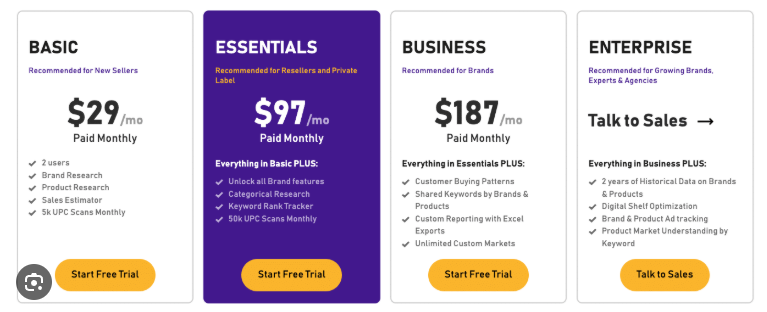
SmartScout pricing starts from $29 per month on a monthly plan and $25 per month on an annual billing plan. Going for an annual plan can save you up to 30%. SmartScout offers four main plans: Basic, Essentials, Business, and Enterprise.
The Basic plan at $29 per month gives first-time sellers access to brand and competitive research, 5,000 UPC scans monthly, a sales estimator, Chrome Extension, Search Trends Explorer, Keyword Rank Tracker, and the AI Listing Architect. For someone just starting to build an Amazon business with serious data, this is a functional and affordable entry point.
The Essentials plan steps up to include the full 40,000 subcategory access and market research tools — the tier where SmartScout’s unique features really start to deliver their value.
Business and Enterprise tiers add data export capabilities, API access, advanced team management, and custom data solutions for agencies and larger sellers.
One criticism from a G2 reviewer flags the higher-tier pricing as steep, specifically noting that $158 for the Excel download option feels high. This is a legitimate point for budget-conscious sellers — SmartScout’s advanced export and API features are priced for established businesses with real revenue to protect, not for hobbyists testing the waters.
A 7-day free trial exists so you can experience the platform before committing.
What SmartScout Doesn’t Do Well
Every honest review has to address limitations, and SmartScout has a few that are worth naming clearly.
SmartScout offers limited keyword research opportunities, which are essential for ad and listing optimization. This means sellers often need a second tool alongside SmartScout for comprehensive keyword management.
This is accurate and important. SmartScout’s keyword tools are useful but not as deep as dedicated keyword research platforms like Helium 10’s Cerebro or Jungle Scout’s keyword tools. If keyword research and PPC optimization are your primary concerns, SmartScout alone may leave gaps.
SmartScout lacks inventory management and review automation features. It is a research and intelligence tool, not an operations platform. You won’t manage your inventory here, automate your customer communication, or handle your repricing. These are deliberate scope choices — SmartScout stays focused on what it does exceptionally well — but they mean you’ll still need operational tools alongside it.
The Chrome Extension lags behind competitors in terms of offering features for checking sales history, as this option is only available on the SmartScout website. For sellers who live in the Chrome Extension during their product research, this can create friction in the workflow.

SmartScout vs. Helium 10 vs. Jungle Scout: The Honest Comparison
The comparison that comes up constantly is SmartScout versus Helium 10 or Jungle Scout. Here’s the direct take:
SmartScout is the undisputed king of wholesale sourcing and brand intelligence. While it may lack the all-in-one polish of Helium 10 for private label beginners, its unique features give sellers a competitive edge that other tools simply can’t match. If your goal is to find profitable brands and established market gaps rather than just individual products, SmartScout is highly recommended.
Helium 10 and Jungle Scout are better rounded for private label sellers who need keyword research, listing optimization, review management, and profit tracking all in one platform. If you’re launching your first private label product and need a comprehensive beginner’s toolkit, either of those platforms has a more complete feature set for that specific use case.
SmartScout wins decisively when the business model is wholesale, online arbitrage, or any strategy that requires understanding the brand and market landscape before making product decisions. The Subcategories tool and Brand Explorer have no genuine competitors. The Seller Map is unique. The AdSpy PPC intelligence goes deeper than alternatives. For these use cases, SmartScout isn’t just better — it’s doing things no other tool does.
Many serious sellers use SmartScout alongside Helium 10 or a dedicated keyword tool, treating the two as complementary rather than competitive.
Who Should Subscribe to SmartScout
SmartScout makes the most sense for wholesale sellers who need to identify and approach brands systematically and at scale, online arbitrage buyers who want to process large distributor price lists efficiently, established private label sellers who have moved past basic product research and need market-level intelligence, Amazon agencies who need data to prospect clients and understand competitive landscapes, and brands selling on Amazon who want to monitor their own market share and identify unauthorized resellers.
SmartScout is probably not your first choice if you’re a complete beginner who needs a comprehensive all-in-one platform with guided onboarding and review automation, if keyword research and deep PPC optimization are your primary needs and you only have budget for one tool, or if you’re a casual seller running small volumes where the data depth outpaces your actual decision-making needs.
The Final Verdict: Purpose-Built Intelligence That Earns Its Cost
SmartScout doesn’t try to be everything to everyone. It is purpose-built for sellers who understand that data quality and market intelligence are competitive advantages — and who are sophisticated enough to use that intelligence effectively.
One G2 user summarizes it well: “What we’ve done the manual way for so many years is now mostly automated and reduces the amount of time dramatically in how we source for brands and products. This program has allowed us to increase our productivity dramatically.”
That’s the right frame for evaluating SmartScout. Not “does this replace every other tool I have?” but “does this make the research work I do dramatically faster, more data-driven, and more likely to surface opportunities I’d otherwise miss?” For wholesale and brand-focused Amazon sellers, the answer is consistently yes.
In a marketplace where the sellers who systematize their intelligence gathering are the ones who dominate their categories, SmartScout is infrastructure. Not a nice-to-have. Infrastructure.
⭐ SmartScout Full Scorecard 2026
| Category | Score | Notes |
|---|---|---|
| Subcategory Research | 10/10 | 43,000+ subcategories — nothing else comes close |
| Brand Intelligence | 9.5/10 | Best wholesale sourcing tool in the market |
| Seller Map & Analysis | 9.0/10 | Unique, underrated, genuinely useful |
| Traffic & PPC Intelligence | 9.0/10 | AdSpy + Traffic Graph combo is powerful |
| UPC Scanner | 9.5/10 | Transforms wholesale price list analysis |
| Keyword Research | 6.5/10 | Functional but not as deep as dedicated tools |
| AI Listing Architect | 8.0/10 | Solid, context-rich AI listing builder |
| Pricing & Value | 8.5/10 | Entry tier affordable, top tiers priced for serious sellers |
| Ease of Use | 8.0/10 | Clean UI, slight learning curve on advanced features |
| Customer Support | 9.0/10 | Consistently praised across user reviews |
| Overall Rating | 🌟 4.5 / 5 | Best brand-focused Amazon intelligence tool in 2026 |
This review is based on publicly available user feedback, independent editorial testing, and published platform documentation. Features and pricing may change — always verify current details directly with the platform.